
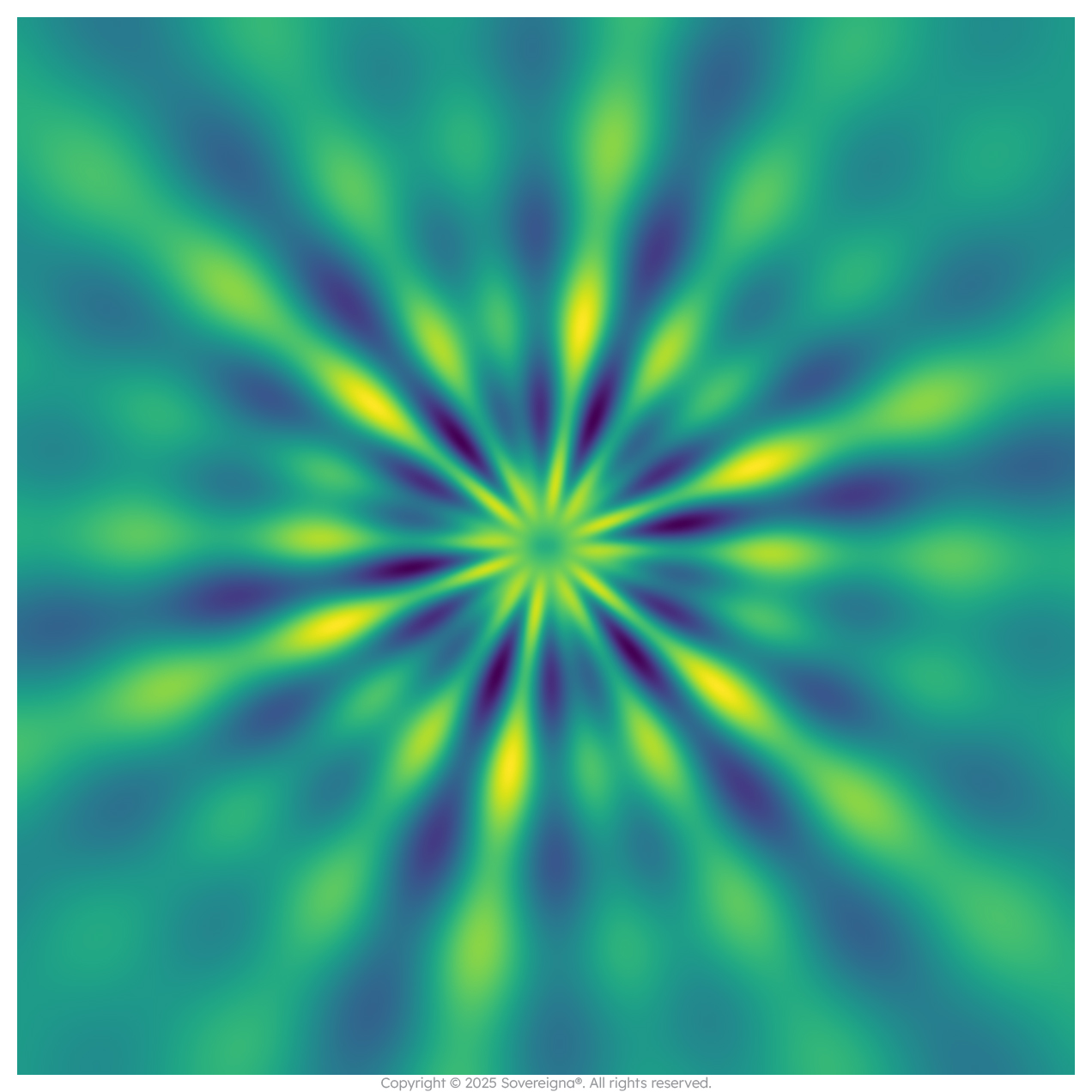
Sequential Optical Triggers (SOTs): A New Framework for Perceptual Flow in Visual Therapeutics
by:
Saba Harati, Lim Yao-han, Agnes James & Shamim Shafiee
27 March 2025
About This Work
This whitepaper reflects firsthand experimentation, lived observation, and early-stage response patterns from informal testers. It is not a formal study or a peer-reviewed document—but it was created with care, caution, and an open door for future research and refinement. Some sections were written in collaboration with AI (CGPT), used as a co-thinker and ethical design partner—guided by human vision and values.
Note on Long-Term Use
As of now, no formal studies exist on the long-term effects of SOT exposure. While current use appears safe and supportive for most viewers, we advise users to approach them with balance.
SOTs are best used as tools for calming, not constants of experience.
Co-use with screen-based or neuro-entraining tools (e.g. meditation apps, EMDR lights, VR) should be explored with care.
Abstract
Sequential Optical Triggers (SOTs) represent a novel approach to visual design focused on creating directed perceptual flow rather than isolated illusions. Rooted in a fusion of optical illusion theory, rhythm design, and psychological regulation, SOTs function as modular perceptual stimuli. This paper introduces the foundational theory of SOTs, contrasting them with traditional optical illusions, and proposes their therapeutic potential in sensory regulation, especially for neurodivergent individuals experiencing overstimulation, anxiety, or hyperactivity cycles.
Introduction
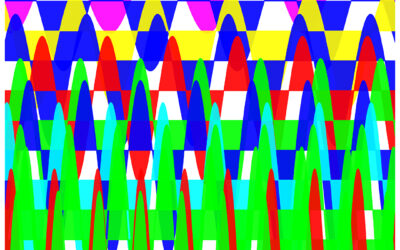
Traditional optical illusions engage the viewer through perceptual contradiction: impossible geometry, motion illusions, ambiguous space. They are static enigmas. Sequential Optical Triggers (SOTs), by contrast, are not tricks but tools—intentional arrangements of visual elements designed to guide attention and modulate cognitive rhythm.
While visual illusions have historically been used in art, entertainment, and neuroscience, SOTs have immediate applicability in therapeutic design. We explore their construction, impact, and implications for emotional regulation and first-aid calming protocols.
Definition of SOTs
Sequential Optical Triggers (SOTs) are structured visual compositions that combine multiple optical elements (color, contrast, pattern, motion cues) into a sequential rhythm that:
- Directs the eye intentionally across space
- Produces a wave-like experience of visual flow
- Modulates internal tempo of the viewer
- Can be scaled for therapeutic impact: calming, activating, or grounding
Unlike traditional illusions, SOTs are perceptual tools, not tricks.
Origins and Rationale
The term “SOT” emerged organically through iterative design sessions in which the authors attempted to simulate motion and depth through static patterns. We noticed that while traditional illusions produced a sense of surprise or wonder, our patterns—though “uglier” by aesthetic standards—produced something different: a soothing, guiding effect. They entrained the gaze.
This entrainment led to physiological observations: slowed breath, reduced blinking, and in some cases, interruption of overstimulated mental states.
We realized we weren’t creating illusions but instead we were building visual tempo machines.
It is also worth noting that one of the authors’ earliest design experiences was using the 1980s IBM LOGO programming language. Before MS Paint, before design software, there was a turtle on a screen that could be told to move in geometric loops. It was here—drawing spirals and recursive turns—that the seed of procedural visual flow was first planted. SOTs are, in many ways, the emotional descendants of that turtle: still looping, still spiraling, but now with intention.
Comparison to Traditional Illusions
| Feature | Traditional Optical Illusion | SOT |
| Purpose | Surprise, contradiction | Flow, guidance |
| Viewer Role | Observer | Participant (gaze entrained) |
| Composition | Static trick | Sequenced rhythm |
| Application | Art, cognitive curiosity | Therapy, UI, attention aid |
| Perceptual Impact | Momentary disruption | Sustained modulation |
Potential Therapeutic Use Cases
- First Aid for Zoomies (Hyperarousal / ADHD surges):
- SOTs can offer a safe visual anchor to discharge excess cognitive energy.
- Unlike verbal cues or breathing apps, SOTs require no conscious engagement.
- Sensory Soothing for Autism Spectrum:
- Repetitive, rhythmic visuals mimic stim behavior
- May function like a visual fidget spinner: entrancing without overloading
- Anxiety Grounding:
- Eye movement across structured sequences stabilizes internal pacing
- Pacing can be designed to align with breath cycles or calming patterns
- Post-Event Regulation:
- After meltdowns, SOTs can serve as recovery visuals
- Dementia & Cognitive Anchoring:
- SOTs may act as non-verbal cognitive anchors
- When seen, SOT patterns can trigger visual grounding
- A family observation: a relative with dementia calms when spinning a ring and gazing into it—SOTs aim to replicate this intuitive behavior visually, without actual physical movement
How to Create a Basic SOT (For Beginners)
Creating a Sequential Optical Trigger doesn’t require advanced tools or training. At its core, an SOT is a looping visual rhythm that guides the viewer’s eye. Here’s how to start:
- Choose Your Base Structure:
- Spiral (inward or outward)
- Circular rings
- Zigzag waves
- Select a Repeating Element:
- Dots, lines, arrows, small shapes
- Consistency is more important than detail
- Create Directional Flow:
- Slight rotation or offset per layer
- Gradual shift in spacing or size
- Modulate Visual Intensity:
- Use brightness, contrast, or saturation to create pulse-like energy
- Keep shifts smooth and rhythmic, not abrupt
- Select Your Palette Based on Intent:
- Calming: cool tones, soft transitions
- Energizing: warm tones, sharp edges
- Test It:
- View from different distances
- Blink, squint, or gently move your head to see how the flow reacts
Note: Start simple. The power of SOTs lies in their rhythm, not complexity.
Design Principles of SOTs
- Rhythmic Flow: Eye movement must have continuity (spiral, wave, loop)
- Optical Triggers: Use contrast, shape, brightness to create subtle micro-surprises
- Sequential Framing: Design should reward continued viewing
- Tempo Control: Adjust spacing, size, and intensity to slow or accelerate perception
Color Psychology: Use chromatics not for beauty, but for modulation (e.g., purple-yellow for alert-calm balance)
Energizing Effects
While much of the SOT exploration has focused on soothing, grounding, and regulating effects, some sequences appear to have the opposite impact: stimulation, alertness, and gentle activation. Early testers have reported that certain patterns—particularly those with high-frequency contrast, radial pulses, or warm color acceleration (e.g., red-orange flashes or geometric expansions)—evoke feelings of:
- Increased energy or cognitive wakefulness
- Renewed motivation or “visual caffeine”
- Focus without fixation
These responses are still anecdotal, and likely depend on the viewer’s neurotype, state of mind, and visual tolerance. However, the suggestion that SOTs can be tuned for energizing as well as calming outcomes opens a valuable dual-track design approach.
Therapists and designers may eventually tailor SOT sequences along a perceptual spectrum: from sedation to stimulation.
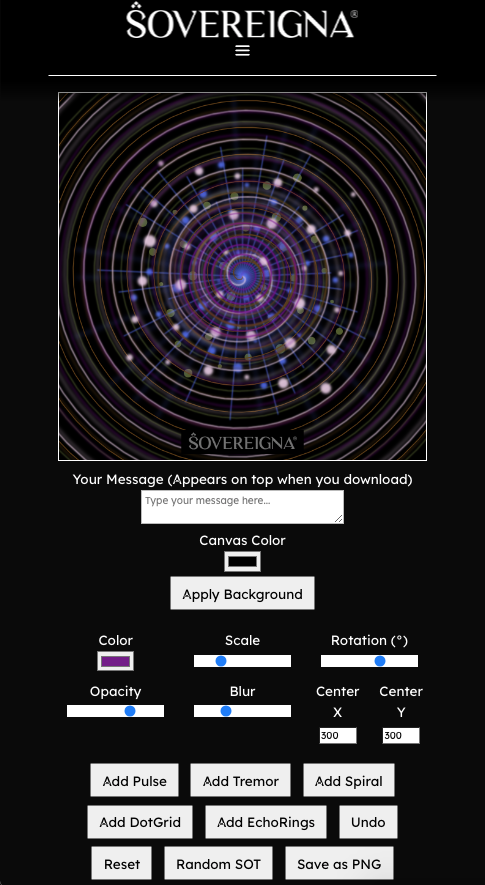
Create your own SOTs at https://sovereigna.com/sotmaker/
Observations
- SOTs often appear “ugly” compared to refined optical art. This may reflect a shift from aesthetic appeal to functional visual engineering.
- Viewers with ADHD, PTSD, sensory sensitivity, and dementia have reported nonverbal relief or anchoring when interacting with SOTs.
SOT Viewing Guidelines: Conditions That Affect Perception
Sequential Optical Triggers (SOTs) are designed to activate or soothe visual perception through still, layered imagery. However, their effectiveness can vary widely depending on the environment, the viewer’s state, and even subtle visual conditions.
Below are common factors that may reduce, distort, or intensify the intended effect of a SOT:
1. Viewing Size
- Too Small: Detail and sequence may be lost. Some patterns collapse into static noise.
- Too Large: Can overwhelm the visual field and obscure the “whole” effect.
- Ideal Range: Between 4–10 inches (10–25 cm) in diameter for most designs.
2. Viewing Distance
- Too Close: Eye strain may increase, especially in high-density illusions.
- Too Far: Patterns may blur into uniformity.
- Suggested Distance: Arm’s length or slightly closer. Enough to take in the entire form without moving the head.
3. Background Interference
- Moving Backgrounds: Traffic, TV, dynamic websites, or flashing lights can conflict with the SOT’s micro-movements and visual rhythm.
- Visual Noise: Cluttered pages, ads, or chat overlays diminish impact.
- Recommendation: Fullscreen, print, or plain background for best results.
4. Lighting Conditions
- Too Dim: Visual detail and contrast may fade.
- Too Bright: Glare may flatten the illusion or wash out color perception.
- Ideal Lighting: Soft, indirect light with minimal screen reflection.
5. Eye State
- Fatigue or strain may dull the effect or trigger irritation.
- Hyperfocus may override the soft-gaze method SOTs often rely on.
- Encouraged Practice: Blink naturally. Let the gaze soften and hover.
6. Motion and Posture
- Moving while viewing (walking, commuting) reduces anchoring impact.
- Head tilt or screen skew can distort radial or spiral illusions.
- Optimal Setup: Seated, centered, minimal head movement.
7. Device Resolution or Print Quality
- Low-resolution displays or compressed images can create visual artifacts.
- Poor printing may remove subtle contrast layers needed for the illusion.
- Recommendation: High-quality print or retina-level digital screens for full effect.
8. Cognitive Readiness
- Distracted, multitasking, or overstimulated states may reduce perceptual depth.
- Gentle breath and stillness often enhance the experience.
Perception is not passive. These guidelines help preserve the integrity of the SOT and the sensitivity of the viewer.
Risks and Ethical Considerations
While SOTs show promising therapeutic potential, it is essential to acknowledge possible risks:
- Overstimulation: For some users—particularly those sensitive to light, contrast, or motion cues—SOTs may cause disorientation, nausea, or headaches.
- Entrapment Effect: The rhythmic visual pull may become compulsive or overused by individuals prone to fixation, potentially reinforcing unhelpful loops in OCD, trauma responses, or dissociative states.
- Accessibility Limitations: Certain visual impairments may render SOTs ineffective or even frustrating. Future versions must consider adaptable formats (e.g., haptic or auditory translations).
- Inadvertent Triggers: SOTs involving spirals, pulsation, or intense contrast may inadvertently mimic visual triggers found in traumatic flashbacks, seizures, or migraines.
We recommend all SOT designs include:
- Clear usage guidance
- Adjustable intensity
- An opt-out or “soft stop” point
This framework must evolve in dialogue with clinicians, accessibility experts, and users with lived experience.
Notes on Scope and Method
This paper presents early-stage observations and a conceptual framework. While no formal research trials or citations are included, the intention is to seed a new field of inquiry. We welcome collaboration, critique, and exploration by psychologists, artists, and engineers alike.
Perception and Non-Perception
We describe SOTs as “first aid for perception”—but it is worth considering what happens in states of non-perception as well. Individuals experiencing dissociation, neurological shutdowns, sensory numbing, or catatonia may not be able to engage with the world through standard perception.
In these cases, SOTs may serve a secondary role—not as a direct perceptual tool, but as a lure or bridge. Their repetition, color cycles, and low-effort visual entry points may offer just enough patterned stimulation to gently reinitiate perceptual engagement.
In this light, SOTs are not only for calming the overstimulated, but may also reach toward those momentarily disconnected from sensory reality.
They may whisper, rather than call.
Are SOTs Fractals?
While Sequential Optical Triggers may appear fractal-like—especially when involving spirals, concentric rings, or repeating micro-patterns—they are not true fractals in the mathematical sense. Fractals exhibit infinite recursion and self-similarity across scale. SOTs, by contrast, are designed with finite rhythmic intention.
However, both systems share qualities that influence perception:
- Repetition
- Patterned flow
- Hypnotic or entrancing visual characteristics
SOTs draw from fractal aesthetics, but are purpose-built for perceptual modulation, not for mathematical infinity or natural mimicry. They are intentional sequences, not recursive systems.
Conclusion
Sequential Optical Triggers are more than visuals. They are perceptual tools—modular, scalable, and emotionally intelligent. We believe they belong in every psychological toolkit, not just as art, but as first aid for perception.
We invite researchers, designers, and therapists to explore and evolve this framework.
References and Inspirations
This paper is grounded in both original exploration and a broad legacy of optical and perceptual research. While no formal citations were used in drafting, the following sources, movements, and individuals have influenced the development of the SOT concept:
- Akiyoshi Kitaoka – motion illusion studies and visual flow patterns
- Bridget Riley – Op Art and rhythmic perception
- Victor Vasarely – geometric illusion and dynamic contrast
- Research on visual entrainment and brainwave modulation
- Eye Movement Desensitization and Reprocessing (EMDR)
- Sensory Integration Therapy for Autism Spectrum Disorders
- Neuroaesthetics and affective response to visual stimuli
- Anecdotal observations from neurodivergent individuals and caregivers
- Firsthand exploration using matplotlib, iterative design, and AI-assisted visual prototypes
While studies have explored how rhythmic visual input can entrain attention, modulate neural oscillations, or support trauma processing (as in EMDR), little research directly examines optical illusions as therapeutic anchors. SOTs aim to fill that gap by bridging perception science with psychological application.
We also acknowledge the many unnamed artists, thinkers, and users who have experimented with perception, not to deceive—but to guide, calm, and awaken.
Thank you.
Future Work and Recommendations
As our interest in SOTs grows, we invite careful, collaborative research into their applications across diverse clinical and neurological contexts.
Suggested Future Directions:
- Clinical testing for therapeutic outcomes (e.g. anxiety, sensory regulation, ADHD, PTSD)
- Designing SOTs for low-vision and colorblind accessibility
- Exploring energizing vs. calming perceptual effects
- Defining safe exposure durations and thresholds for visual fatigue
- Cross-cultural studies on perception, symbolism, and visual literacy
- Formal psychological testing of SOT impact on heart rate, breath, and eye movement
- Integration into AR/VR environments for active neurotherapy
- Exploration of SOTs in user interface design for digital mental health tools
- Cross-disciplinary research into visual entrainment, neuroplasticity, and memory care
New Emerging Hypothesis:
SOTs as potential counter-hallucination anchors?
Early conceptual work suggests SOTs may hold value in:
- Parkinson’s-related visual hallucinations
- Psychosis spectrum disorders
- Dissociative states
- Dementia-related perceptual disruptions
Due to their controlled, shared, and repeatable illusionary behavior, SOTs may serve as perceptual “anchors” that invite the brain to stabilize through gentle, known distortions rather than unpredictable hallucinations.
This is an emerging concept and should be treated with caution. No clinical evidence currently supports this use. However, it offers a promising avenue for collaboration between artists, psychologists, neurologists, and vision scientists.
We do not claim therapeutic efficacy—only design intent. Clinical validation is essential before any implementation.
0 Comments